Tell us about the job
Takes about a minute. No obligation.
A compressor sitting unused for years does not stay ready. Seals dry, contacts corrode, and the refrigerant circuit that depends on regular cycling to stay lubricated goes without it. Homes in Benton County, OR have essentially no cooling season — no month of the year is warm enough to call for it. When a contractor opens a central AC unit here, the wear pattern reflects dormancy rather than overwork, which means the usual checklist built around a hard-running system can point to the wrong cause. Contactor pitting and capacitor degradation from standing idle look different from the same parts run ragged by heat, and a diagnosis that skips that distinction prices the job wrong.
Half the homes in Benton County, Oregon were built in 1979 or earlier (2020-2024 ACS 5-year). For a repair job, that vintage of housing means the ductwork a central AC system moves air through has had a long time to collect debris, lose seal integrity at joints, and restrict airflow in ways the unit itself takes the blame for. A contractor who opens the equipment may find a compressor or evaporator coil stressed by conditions the duct system created, not by the component's own age. Whether the part that failed is still manufactured is a separate question, and for systems running in houses this old it is one a contractor has to answer before quoting the repair.
The Parts of a Central AC a Contractor Checks During a Repair
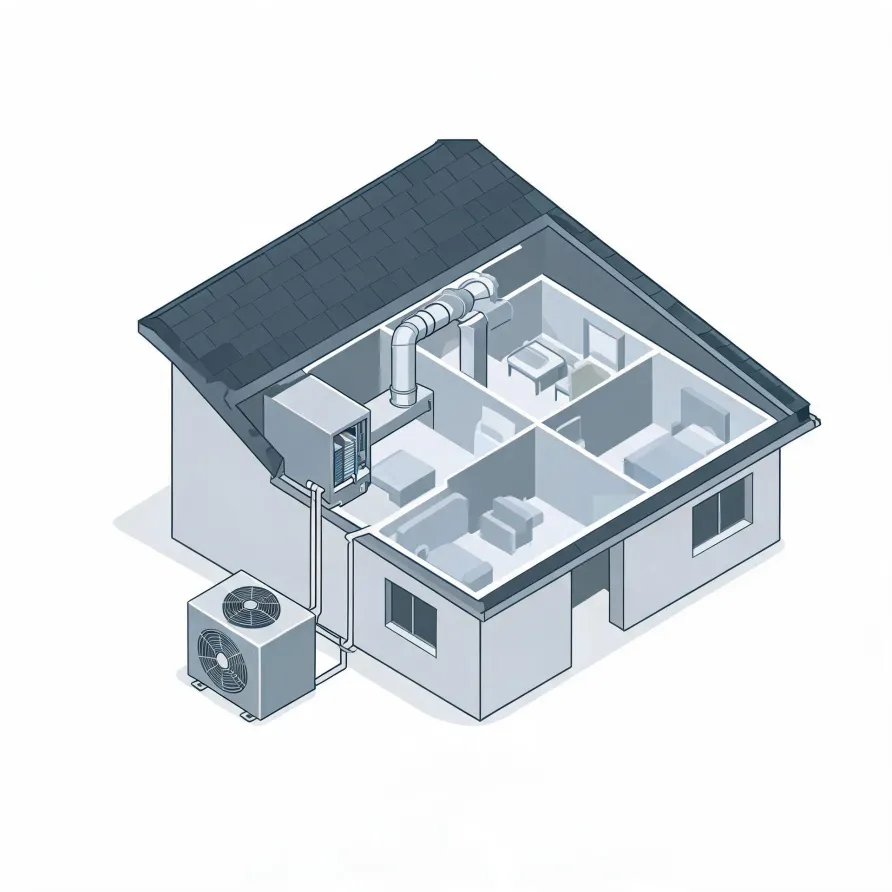
The outdoor condenser unit sits outside the house, usually on a concrete pad at ground level, and it holds the compressor and condenser coil. These are the pieces a contractor reaches first when the system stops cooling, because a failed compressor or a dirty, damaged coil accounts for a large share of repair calls.
Inside the house, the air handler or furnace cabinet holds the evaporator coil and the blower. The evaporator coil is where refrigerant does its work, so a leak or a frozen coil here explains why a system runs but delivers no relief. The blower moves conditioned air into the ducts, and a worn motor or a failed capacitor will stop it.
The drawing shows a typical layout, and a licensed contractor determines which components apply and what condition they are in for your specific house.
Get matched in Benton CountyBenton County, by the numbers
2 severe weather events were recorded in Benton County, Oregon between 2015 and 2024.
NOAA National Centers for Environmental Information, Storm Events Database, bulk CSV export, events 2015-01-01 through 2024-12-31.Half the homes in Benton County, Oregon were built in 1979 or earlier (2020-2024 ACS 5-year).
U.S. Census Bureau, 2020-2024 American Community Survey 5-Year EstimatesBenton County, Oregon holds 40,951 housing units (2020-2024 ACS 5-year).
U.S. Census Bureau, 2020-2024 American Community Survey 5-Year EstimatesOwners occupy 56.9% of the occupied homes in Benton County, Oregon (2020-2024 ACS 5-year).
U.S. Census Bureau, 2020-2024 American Community Survey 5-Year EstimatesCodes & Standards Covering Central AC Repair in Benton County, Oregon10 sourced rules and standards
What repair work in Benton County actually looks like
Split-system central air conditioners rated below 45,000 Btu/h manufactured on or after January 1, 2023 must meet a federal minimum of 13.4 SEER2.
Split-system central air conditioners rated at or above 45,000 Btu/h manufactured on or after January 1, 2023 must meet a federal minimum of 13.4 SEER2.
Split-system central air conditioners manufactured between January 1, 2015 and December 31, 2022 had to meet 13 SEER, the metric that preceded SEER2.
Single-package central air conditioners manufactured on or after January 1, 2023 must meet a federal minimum of 13.4 SEER2.
Space-constrained central air conditioners manufactured on or after January 1, 2023 must meet a federal minimum of 11.7 SEER2.
Federal efficiency standards for split-system central air conditioners and heat pumps are set on each certified combination of outdoor unit and indoor coil rather than on the outdoor unit alone.
Residential and light commercial air conditioning and heat pump systems assembled in the field, including mini-splits and unitary systems, may not be installed on or after January 1, 2025 using a refrigerant with a global warming potential above 700.
A field-assembled system whose specified components were all manufactured or imported before January 1, 2025 carries no installation compliance date under the refrigerant restrictions and may still be installed.
Licensing Rules for HVAC Repair in Benton County, Oregon
Oregon’s contractor licence does not reach casual, minor or inconsequential work on one structure where the person’s contracts total less than $1,000 — and the exemption is unavailable to anyone who advertises or signs themselves as a contractor, at any price.
Oregon requires a current Construction Contractors Board licence, with the right endorsement, to undertake, offer to undertake or bid construction work.